
🌊 SturNet: Monthly monitoring of the Black Sea basin – results from Bulgaria
- Jul 22, 2025
- 2 min read
Since March 2025, we have started the implementation of water quality monitoring and eDNA analysis activities as part of the international SturNet project, funded under the INTERREG NEXT Black Sea Basin program of the European Union. Independent sampling is carried out in five countries of the Black Sea Basin: Ukraine, Moldova, Romania, Bulgaria and Turkey.
🌍 The power of science is in collaboration!
The main goal of the activity is to track monthly changes in key parameters of the aquatic environment that can affect biodiversity and the general ecological state of coastal waters, and their impact on sturgeon populations.
📍 Bulgarian point – Primorsko
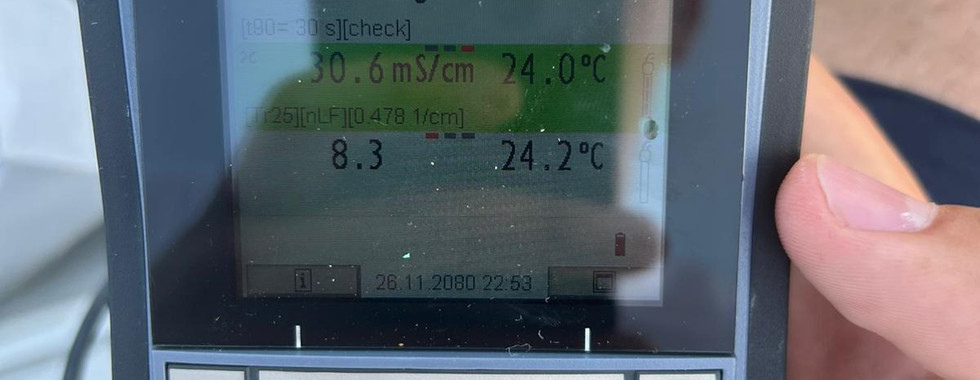
Sampling is carried out at 2 different depths – 2/3 and near the bottom – in the waters off Primorsko. The first nine samples, collected from March to July 2025, show stable physicochemical characteristics, such as:
✅ Main parameters:
Temperature: from 8.2°C (March) to 25°C (July)
pH: between 8.3 and 8.7 – typical alkalinity for seawater
Electrical conductivity: 27.5 – 30.9 mS/cm, corresponding to typical seawater indicators
Dissolved oxygen: 7.21 – 12.3 mg/l – sufficient levels to support marine life




Sharp temperature jump in June
In the period from May to June, a sharp increase in water temperature is observed - from ~13.5°C on 18.5.2025 to 23.8°C on 23.6.2025, or almost +10°C within a month. This is due to an early and intense summer wave, which accelerates the warming of the surface layers. Such warming may affect:
Water stratification - possible limited mixing of the layers
Oxygen dynamics - increased temperature reduces dissolved oxygen
Plankton and microbiome activity
Nutrient indicators in July
In July, nutrient values recorded in the coastal zone near Primorsko show very low concentrations of nitrates (<0.2 mg/L) and nitrites (0.0084 mg/L N–NO₂), which is typical for clean seawater. Phosphates (0.08 mg/L PO₄-P) are moderately elevated, which may indicate a limited local contribution of anthropogenic origin.
Monthly monitoring will continue until December 2025, with the aim of building a comprehensive ecological profile of the coastal zone in the Black Sea.
Extraction of eDNA from the collected samples is in progress, and the analyses will show which species (native and invasive) are present in the ecosystem.


Comments