
Transnational SturNet Meeting in Chișinău
- Dec 8, 2025
- 3 min read
On 3–4 December, a transnational working meeting under the SturNet project took place in Chișinău, Moldova, hosted by our partner Ecological Counselling Center Cahul. The event gathered all project partners for a mid-term review of progress and a joint discussion on the next implementation steps – from field activities to future collaborative initiatives across the Black Sea and Danube region.

Presentation of Related International Initiatives
The meeting clearly demonstrated that the conservation of migratory sturgeons cannot be addressed in isolation – it is part of a wider transnational network of expertise, projects, and coordinated action.
▶ WWF CEE / Danube Sturgeon Task Force – проект #MonStur
Ms Beate Striebel presented the new MonStur initiative, which aims to build a joint monitoring system for sturgeons across the entire Danube River Basin and Black Sea.
The project unites 13 partners from 12 countries, alongside 17 strategic partners, to develop shared databases, unified methodologies, and an integrated transboundary monitoring approach. The goal is to move from fragmented national efforts to cooperative management of sturgeon populations — since rivers and migration routes extend far beyond administrative borders.
▶ #BLISS Project – Black Sea Initiative for Sturgeon Sustainability
Prof. Serap Ustaoglu Tiril from Sinop University introduced the newly launched BLISS project, funded by Interreg NEXT Black Sea Basin.
Its focus is on improving research, monitoring, and habitat restoration in rivers such as Yeşilırmak and the Danube. Activities include the use of modern technologies — satellite and acoustic telemetry, PIT tagging, habitat assessment with side-scan sonar, the creation of an International Sturgeon Conservation Network, and extensive community outreach.
▶ Experience from Georgia
Bianca Roberts and Dr Tamar Beridze from Fauna & Flora shared their work on sturgeon conservation in the Rioni River (Georgia), where some of the most innovative regional monitoring practices are being applied.





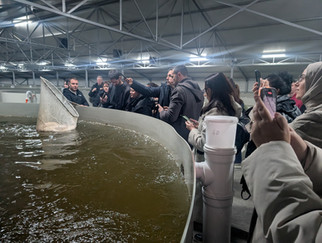


Visit to a Sturgeon Aquaculture Facility
As part of the programme, partners visited a local sturgeon farm, where discussions focused on sustainable aquaculture practices and their potential role in supporting conservation and restocking initiatives.
Why Collaboration Between Projects and Countries Is Essential
Sturgeon conservation is one of the most complex environmental challenges in Europe. Sturgeon species migrate across vast river systems and multiple countries, while the threats they face — illegal fishing, habitat loss, river fragmentation — are transboundary in nature. Effective solutions therefore require coordinated international action.
Projects like SturNet, MonStur, BLISS and national initiatives complement each other through:
Shared data and knowledge – each project covers different rivers, technologies, and methodologies; combining them provides a realistic basin-wide understanding of population status.
Harmonised monitoring methods – comparable data is crucial for assessments at Danube and Black Sea level.
Scientific exchange and capacity building – new tools such as acoustic telemetry, eDNA, or side-scan sonar spread quickly through these partnerships.
Joint advocacy toward policy-makers – unified positions towards institutions like ICPDR, national ministries, or EU bodies have stronger impact.
Local communities connected to a global effort – from Georgia to Bulgaria and Türkiye, engaging local people and fishers becomes more effective when embedded in a broader international framework.
The SturNet project plays a key role in this network — linking scientific teams, institutions, and civil society organisations into a coordinated monitoring system for migratory sturgeon populations.
We extend our heartfelt thanks to Ecological Counselling Center Cahul for the excellent organisation, hospitality, and the opportunity to strengthen our cooperation.


Comments